Spicebush: The Most Useful Shrub in Eastern Woodlands
Spicebush shows up across three seasons, rewards every sense, and once you learn it, you will see it everywhere.
Lindera benzoin grows in the understory of deciduous forests throughout the eastern half of the continent, from Ontario south to Florida and west to Kansas. It favors moist, shaded ground along streams, ravines, and forest edges. In many woodlands, it is one of the most common shrubs at eye level, and most people walk past it without a second look.
That is a missed opportunity. Spicebush is edible across multiple parts of the plant. It makes excellent tea. The berries can be dried and used as a spice. The dried wood catches fire readily and burns well even in damp conditions. For anyone building a broader knowledge of wild plants, spicebush is worth learning early because it delivers so much from a single identification.
Identifying spicebush
The most reliable identification feature is the smell. Scratch a twig or crush a leaf between your fingers and you will get a bright, citrusy, spicy fragrance that is unlike anything else in the eastern forest. Some people describe it as a mix of allspice and lemon. Others compare it to a milder version of sassafras. The scent is strong enough that once you have smelled it, you will recognize it instantly in the future.
This scratch-and-smell test works from spring through fall, anytime the plant has leaves or green twigs. It is one of the most foolproof identification methods for any wild plant because there is no common lookalike in the eastern understory that produces the same fragrance.
Spring
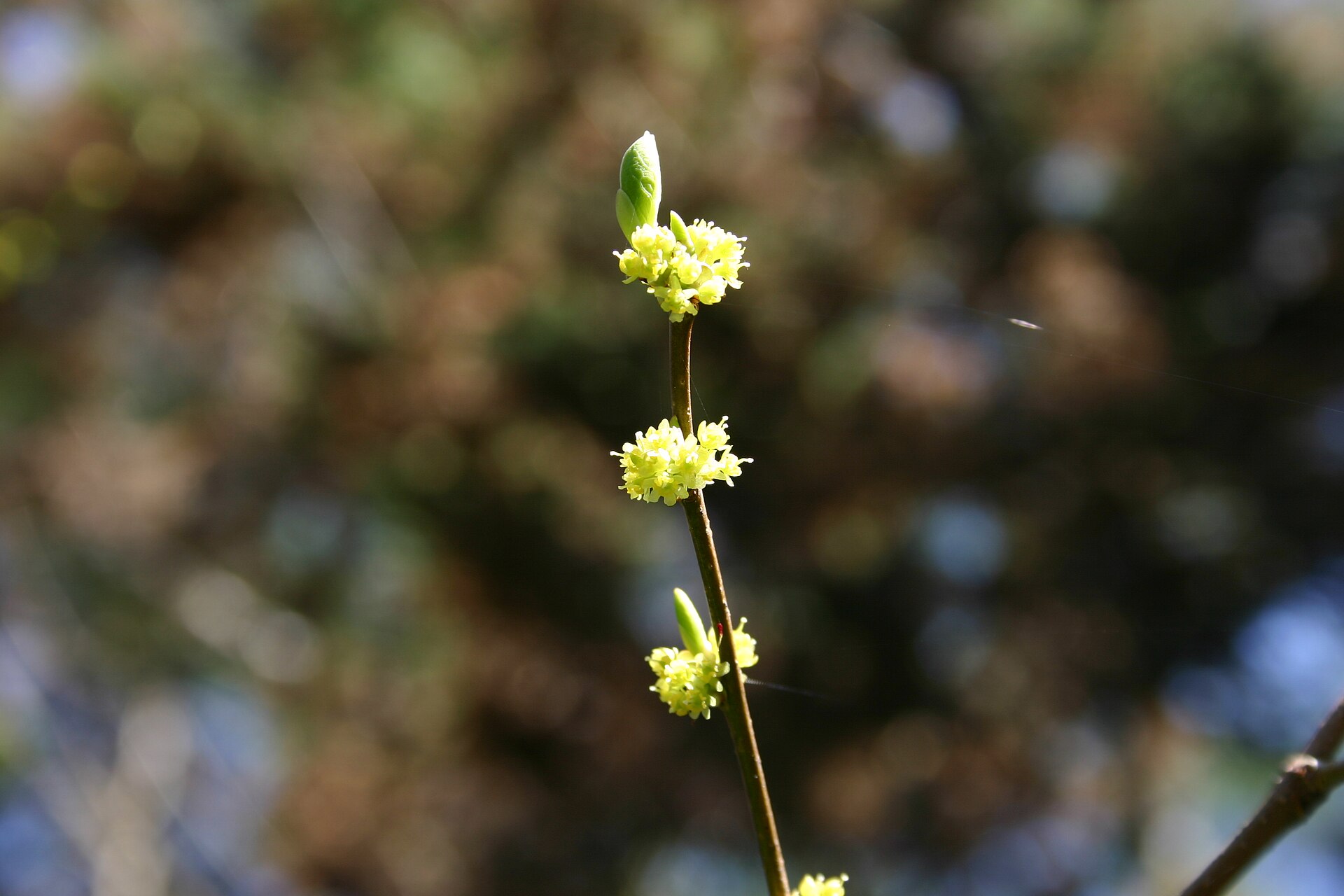
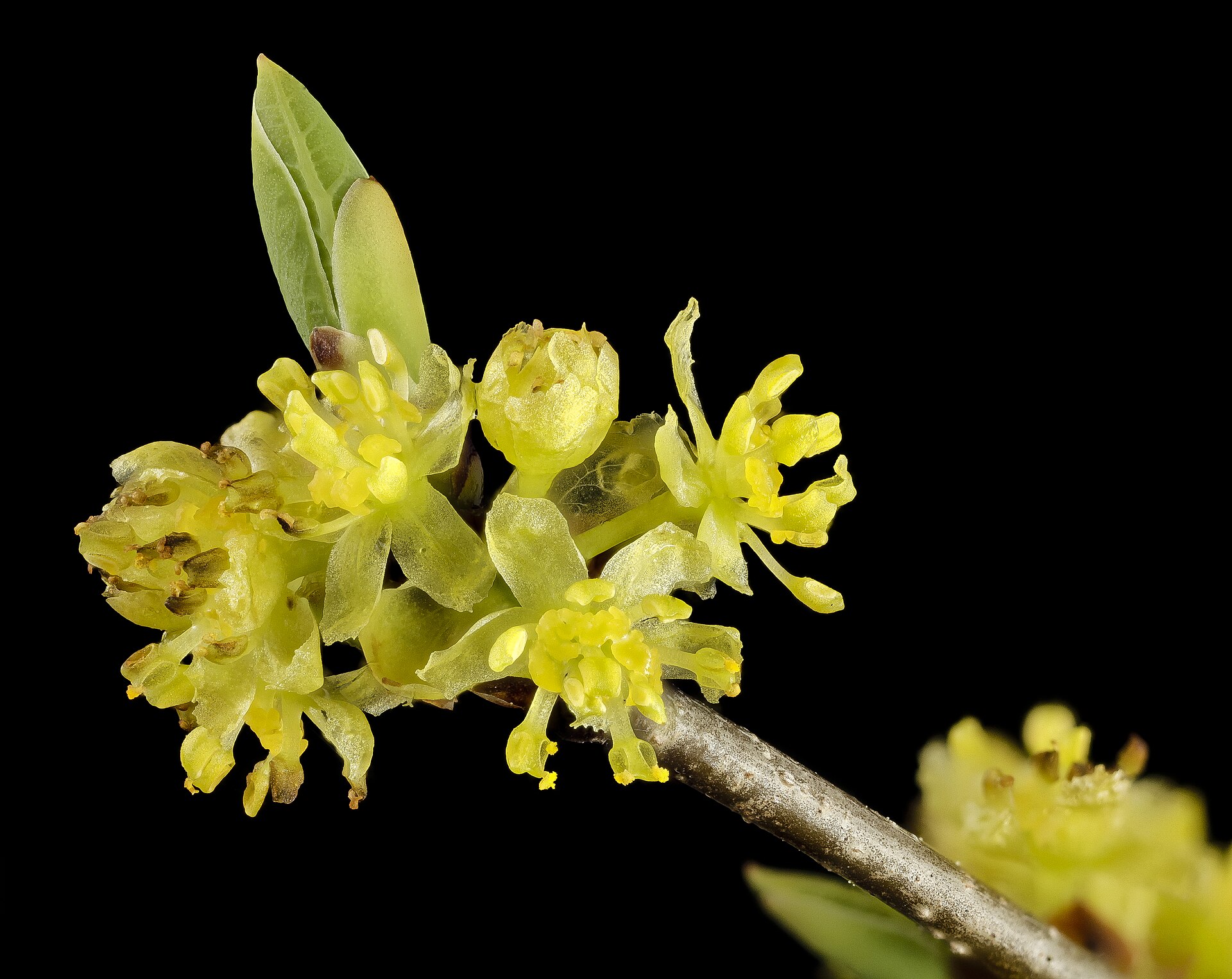
Spicebush is one of the earliest shrubs to flower, often blooming in March or April before the leaves emerge. The flowers are small, yellow, and clustered tightly along the branches. They appear when most of the forest is still bare, which makes them easy to spot. A hillside full of spicebush in early spring looks like someone scattered small yellow sparks across the understory.
The flowers are a useful scouting signal. If you note where spicebush blooms in spring, you know where to return in late summer for berries. The plants do not move.
Summer
Once the leaves come in, spicebush has simple, alternate, smooth-edged leaves that are oval-shaped with a pointed tip. They are bright green on top and paler underneath. The leaves are thin and aromatic when crushed. The branching pattern is alternate, and the twigs are slender with small lenticels (raised dots) visible on the bark.
In summer, the developing fruit is visible as small green drupes clustered along the branches where the flowers were. These are not yet ripe and should be left alone until fall.
Fall
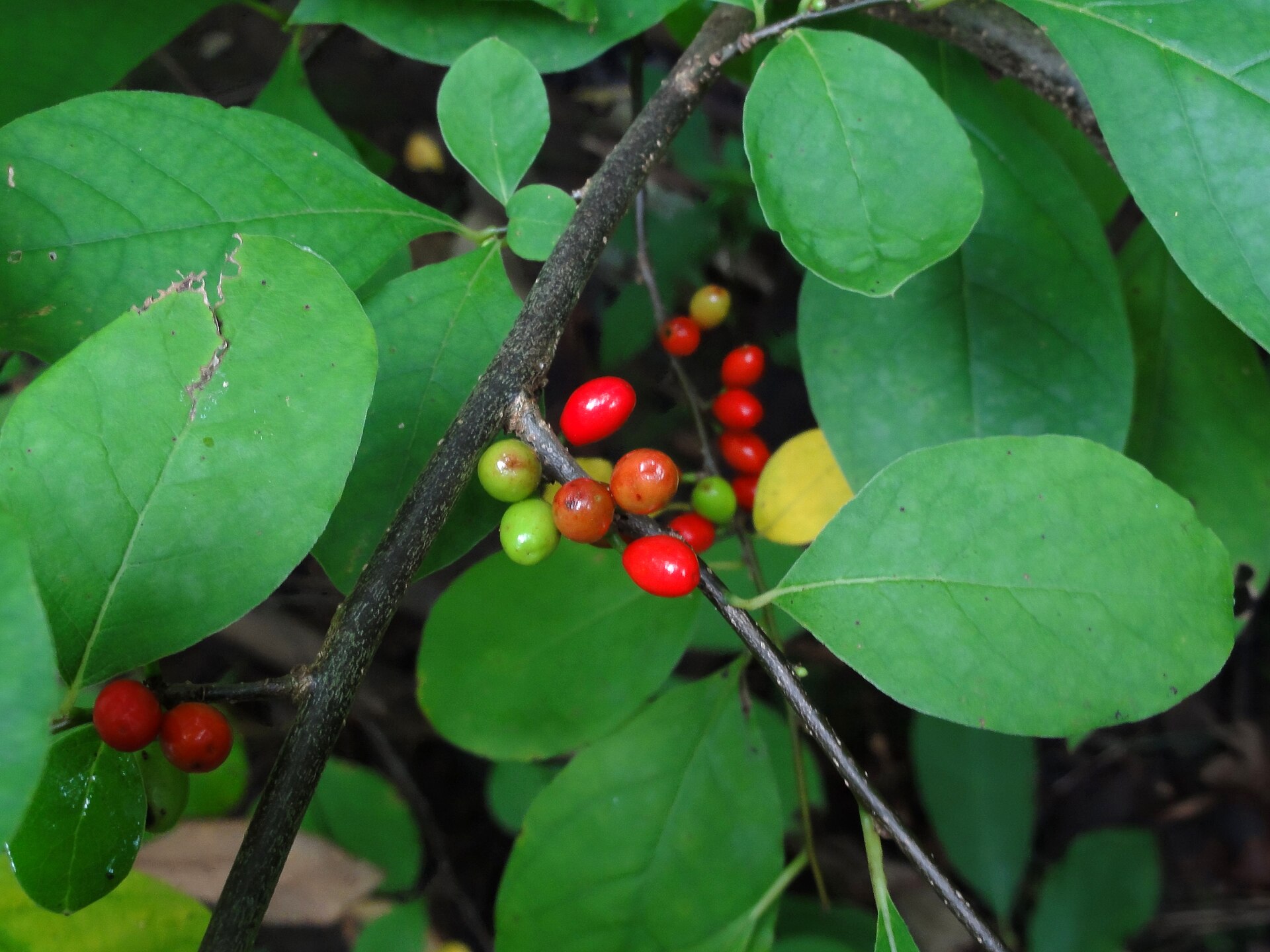
The berries ripen in September and October, turning bright red. They are oval, about the size of a small pea, each containing a single large seed. The red color is vivid against the yellowing leaves, making fall the easiest season to spot spicebush from a distance. The leaves turn a clear yellow before dropping.
Winter
In winter, spicebush is identifiable by its smooth gray bark with visible lenticels, its alternate branching, and the scratch-and-smell test on the twigs. The buds are small and rounded. With practice, you can identify spicebush in winter as reliably as in summer, though it takes more confidence.
Scratch a twig. If it smells bright and spicy, you have spicebush. There is nothing else like it in the eastern woods.
The scratch-and-smell test is distinctive, but it should be combined with visual features (alternate leaves, smooth margins, small yellow spring flowers or red fall berries) to confirm identification. If the twig does not produce a strong citrus-spice scent, it is not spicebush. Walk away. As with all wild edibles, eat only what you can identify with complete certainty.
Spicebush tea
Tea is the simplest and most rewarding use of spicebush. Both the leaves and the twigs work, and the flavor is excellent.
Leaf tea
Pick a handful of fresh leaves from spring through early fall. Tear them into smaller pieces and steep in just-boiled water for five to ten minutes. The result is a mild, aromatic tea with citrus and spice notes. It is pleasant on its own and does not need sweetener. Stronger flavor comes from more leaves and longer steeping, but it does not turn bitter the way many herb teas do.
Twig tea
Snap several small twigs into inch-long pieces and simmer them in water for ten to fifteen minutes. Twig tea has a deeper, more complex flavor than leaf tea, with a woodier spice character. This method works year-round, including in winter when the leaves are gone. A handful of pencil-thin twigs in a pot of water over a campfire produces one of the best wild teas available in the eastern forest.
Twig tea is particularly good when you are cold and tired. The warm spice flavor is restorative in a way that plain hot water is not, and the preparation is simple enough to do at any campsite with a fire and a pot. If you carry an MSR PocketRocket or cook over coals from your fire, it takes less than fifteen minutes from twig to cup.
Dried leaves for later
Spicebush leaves dry well and retain their flavor. Spread them in a single layer in a warm, dry spot out of direct sunlight. Once fully dry and crumbly, store them in a jar. They make good tea through the winter months. Dried twig sections store even longer and can be simmered the same way as fresh ones.
The berries: Appalachian allspice
Spicebush berries have a long history of use as a spice, sometimes called Appalachian allspice or poor man’s allspice. The flavor is warm and complex, somewhere between allspice and black pepper with a citrus edge.
Harvesting
Pick the berries when they are fully red, typically in September or October. They come off the branch easily when ripe. Each berry has a thin flesh surrounding a single large seed. Both the flesh and the seed are aromatic, but the flavor is concentrated in the outer flesh.
Spicebush is dioecious, meaning individual plants are either male or female. Only female plants produce berries. If you find a stand of spicebush with no berries in fall, you may be looking at male plants. Look nearby for female plants, which are often growing in the same area.
Drying and using
Spread the berries on a tray and dry them at room temperature or in a dehydrator on low heat. Once dry, remove the seeds. The dried outer shells can be ground in a spice grinder or mortar and pestle. Use the powder the way you would use allspice: on roasted vegetables, in baked goods, in marinades, or in warm drinks. A small amount goes a long way.
The dried whole berries also store well in a sealed jar and can be ground as needed. They keep their flavor for a year or more.
A single afternoon of berry picking in September can produce enough dried spice to last through winter.
Spicebush as fire fuel
The connection between spicebush and fire building is practical. The aromatic oils in the wood make spicebush twigs and small branches catch fire more easily than many other species, and they burn with a steady flame even when conditions are less than ideal.
Dead spicebush twigs that are still attached to the plant and off the ground are often dry enough to light even after rain. The standing dead wood sheds water better than anything lying on the forest floor. In the wet weather section of the fire-starting guide, this is exactly the kind of material that makes the difference between a fire that catches and one that smokes and dies.
Spicebush is not a primary firewood. The branches are thin and burn fast. But as kindling and early fuel to bridge between tinder and larger wood, it performs well. In a wet forest, it can be the species that saves your fire.
Collect spicebush kindling from standing dead branches, not from the ground. Snap the twigs; if they break cleanly with a crisp sound, they are dry enough to burn. If they bend and flex, they are too green or too wet. This snap test works for kindling from any species, but spicebush passes it more often than most.
Where to find it
Spicebush grows across a broad range but favors specific conditions. Look for it along stream banks, in ravines, on north-facing slopes, and in moist bottomland forests. It tolerates shade well and is often found in the mid-level understory beneath taller trees like tulip poplar, red maple, and beech.
In the right habitat, spicebush can be abundant. Entire stretches of streamside forest may be lined with it. Once you learn to spot the growth habit (a multi-stemmed shrub, typically six to twelve feet tall, with an open, spreading form), you will start noticing it on every walk through eastern deciduous woods.
Spicebush is also a host plant for the spicebush swallowtail butterfly. The caterpillars feed on the leaves and are distinctive: bright green with large false eyespots that make them look like small snakes. Finding these caterpillars on a shrub is another confirmation of identification.
Harvesting responsibly
Spicebush is common throughout its range and is not a conservation concern in most areas. That said, responsible harvesting still applies. Take leaves and twigs from multiple plants rather than stripping a single one. When picking berries, leave plenty for wildlife and for the plant’s own reproduction. The berries are an important food source for migrating birds in fall, particularly wood thrushes, which depend heavily on the high-fat fruit for energy.
Avoid harvesting from roadsides or areas that may have been sprayed with herbicides. Streamside plants in developed areas may be exposed to runoff. The best harvesting comes from plants in intact forest, well away from human activity.
Spicebush at a glance
- Lindera benzoin, found in moist understory throughout eastern woodlands.
- Identify by the scratch-and-smell test: a bright citrus-spice scent from crushed leaves or scratched twigs.
- Yellow flowers in early spring, bright red berries in fall, aromatic twigs year-round.
- Leaves and twigs make excellent tea. Twig tea works in every season.
- Dried berries can be ground and used like allspice.
- Standing dead twigs catch fire readily and burn well even in damp conditions.
- Harvest from healthy forest stands, away from roads and runoff. Leave berries for wildlife.